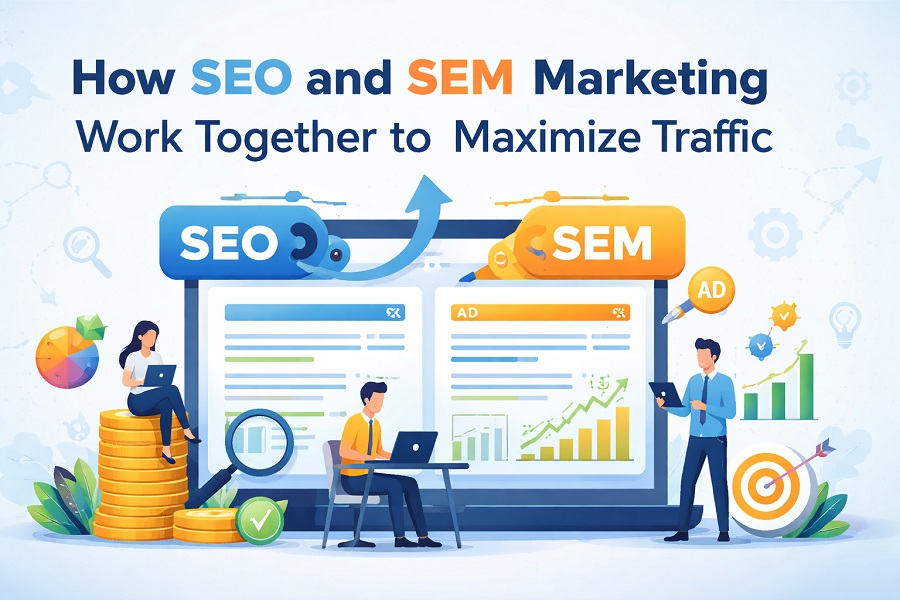
Key Insights
- Integration drives efficiency: Combining SEO and SEM reduces wasted spend and duplicated work.
- Data sharing improves accuracy: Paid campaigns reveal real-time keyword and audience insights.
- Full SERP dominance increases trust: Appearing in both ads and organic results boosts credibility.
- Short-term and long-term balance matters: SEM drives immediate traffic while SEO builds sustainability.
- User intent alignment is critical: Both strategies should target the same search intent for maximum impact.
SEO and SEM Marketing refers to the integrated use of organic search optimization (SEO) and paid search advertising (SEM) to increase visibility, drive targeted traffic, and improve conversions. By combining long-term content strategies with immediate paid campaigns, businesses can maximize search engine presence across multiple touchpoints.
In today’s competitive digital landscape, relying on a single traffic channel is no longer enough. Businesses that dominate search visibility understand one critical truth: sustainable growth comes from integration, not isolation.
This is where SEO and SEM Marketing become powerful—not as separate tactics, but as a unified strategy.
While many marketing teams still treat search engine optimization (SEO) and search engine marketing (SEM) as independent functions, high-performing organizations align them to capture both immediate and long-term traffic opportunities.
This article breaks down how to strategically combine both for maximum impact.
Why SEO and SEM Integration Matters More Than Ever
Search behaviour has evolved. Users now interact with multiple touchpoints before making decisions like clicking ads, reading organic results, comparing content, and revisiting websites.
If your SEO and SEM efforts are disconnected:
- You miss keyword opportunities
- You duplicate efforts
- You waste budget on underperforming strategies
But when aligned:
- Paid data strengthens organic strategy
- Organic insights improve ad performance
- Brand visibility compounds across search results
The result? More qualified traffic, better engagement, and stronger conversion rates.
Understanding the Core Roles of SEO and SEM
Before diving into integration strategies, it’s important to clarify their roles.
SEO: The Long-Term Growth Engine
SEO focuses on:
- Organic rankings: Improves visibility on search engines without paying for clicks.
- Content quality: Provides valuable, relevant information that satisfies user intent and boosts engagement.
- Technical optimization: Enhances site performance, crawlability, and indexing for better search engine understanding.
- Authority building: Builds credibility through backlinks, expertise signals, and consistent, trustworthy content.
It takes time, but delivers:
- Sustainable traffic: Generates consistent, long-term visitors without ongoing advertising spend.
- Higher trust: Users trust organic results more than paid ads, increasing engagement and conversions.
- Lower long-term cost per acquisition: Reduces reliance on paid ads, lowering customer acquisition costs over time.
SEM: The Immediate Traffic Driver
SEM includes:
- Paid search ads: Advertisements displayed on search engines to reach users actively searching relevant keywords.
- Keyword bidding: Competing for specific keywords to determine ad placement and maximize ROI.
- Campaign targeting: Focusing ads on specific audiences, locations, devices, or demographics for relevance.
- Conversion tracking: Measuring user actions post-click to evaluate campaign effectiveness and optimize performance.
It delivers:
- Instant visibility: Quickly positions your brand on search results, reaching potential customers immediately.
- Fast testing capabilities: Enables rapid experimentation with ads, copy, and targeting to optimize results.
- Scalable traffic: Allows campaigns to grow reach and clicks proportionally to budget and strategy.
Individually, both are powerful. Together, they create a compounding growth system.
How SEO and SEM Marketing Work Together
1. Keyword Intelligence Sharing
One of the most effective ways to integrate SEO and SEM Marketing is through shared keyword data.
- SEM campaigns reveal high-converting keywords quickly
- SEO teams can then build content around proven terms
- Low-performing paid keywords can be refined or eliminated
Result: Smarter content strategies backed by real user data.
2. Dominating the Search Engine Results Page (SERP)
When your brand appears in:
- Paid ads (top of page)
- Organic listings (below ads)
You increase:
- Click-through rates (CTRs)
- Brand trust
- Visibility
Users are more likely to engage with brands they see multiple times.
Insight: SERP dominance creates psychological authority.
3. Testing and Scaling Content Strategies
- Headlines
- Messaging
- Offers
- Landing pages
Before investing heavily in SEO content, you can validate:
- What resonates with users
- What converts best
SEO can then scale these insights into:
- Blog content
- Landing pages
- Resource hubs
4. Improving Conversion Rates Together
SEO drives traffic, but SEM refines conversions.
- Use SEM data to identify high-converting user intent
- Optimize SEO pages for better user experience
- Retarget SEO visitors with SEM campaigns
This creates a closed-loop system:
Traffic → Engagement → Conversion → Retargeting
5. Budget Optimization and Risk Reduction
Relying solely on SEM can be expensive but relying solely on SEO can be slow.
By combining both:
- SEM fills traffic gaps while SEO grows
- SEO reduces long-term paid dependency
- Budget allocation becomes more flexible
Outcome: More stable and predictable growth.
Further reading: Secrets of Google SEO Marketing
Practical Integration Strategies
To successfully implement SEO and SEM Marketing, teams need alignment at both strategic and execution levels.
Unified Keyword Strategy
Create a shared keyword database:
- High-intent keywords → SEM focus
- Informational keywords → SEO content
- Overlapping keywords → dual strategy
Shared Analytics and Reporting
Avoid siloed reporting.
Track:
- Combined traffic performance
- Cross-channel conversions
- Keyword overlap success
Use insights to refine both channels continuously.
Aligned Content and Ad Messaging
Ensure consistency across:
- Ad copy
- Meta titles
- Landing pages
Users should experience a seamless journey from search to conversion.
Retargeting Organic Visitors
Use SEM to retarget users who:
- Visited SEO content
- Didn’t convert
This increases:
- Conversion rates
- Brand recall
Continuous Testing and Iteration
SEM provides real-time feedback while SEO provides long-term validation.
Use both to:
- Test fast: Experiment quickly with strategies and messaging to identify what works best.
- Scale smart: Expand campaigns efficiently using data-driven insights from both SEM and SEO.
- Improve continuously: Refine tactics iteratively to enhance performance and long-term growth.
Common Mistakes to Avoid
Even experienced teams struggle with integration. Here are key pitfalls:
- Treating SEO and SEM as separate departments: Creates silos, reducing collaboration, efficiency, and overall search performance.
- Not sharing keyword data between teams: Misses valuable insights that could improve targeting and content strategy.
- Over-investing in paid ads without SEO support: Increases costs without building long-term, sustainable traffic foundations.
- Ignoring user intent differences: Leads to mismatched content and ads, reducing relevance and conversion rates.
- Failing to track cross-channel performance: Limits visibility into combined impact, making optimization and decision-making less effective.
Avoiding the above common mistakes ensures your SEO and SEM Marketing strategy remains cohesive and effective.
Measuring Success
To evaluate your integrated strategy, track:
- Total search visibility (paid + organic)
- Combined click-through rates
- Cost per acquisition (CPA)
- Conversion rates across channels
- Keyword performance overlap
The goal isn’t just traffic—it’s qualified, converting traffic.
Conclusion: Turning Strategy into Scalable Growth
Businesses that succeed in modern search marketing don’t choose between SEO or SEM—they integrate both. By aligning data, strategy, and execution, companies can capture demand at every stage of the customer journey.
The true power of SEO and SEM Marketing lies in synergy:
- SEO builds authority and sustainability
- SEM drives speed and precision
- Together, they maximize visibility, traffic, and conversions
If your current strategy treats them separately, you’re leaving growth on the table.
For businesses looking to scale effectively, partnering with experienced SEO Agencies in Malaysia can accelerate this integration.
Ready to maximize your search traffic? Start integrating, not separating.
FAQs
SEO focuses on organic traffic through content and optimization, while SEM involves paid advertising for immediate visibility.
SEM provides real-time keyword and conversion data, helping SEO teams focus on high-performing search terms.
SEM provides real-time keyword and conversion data, helping SEO teams focus on high-performing search terms.
Yes. Strong SEO rankings can reduce dependency on paid ads, lowering overall cost per acquisition over time.
Ideally, monthly reviews ensure both channels remain aligned, optimized, and responsive to performance data.