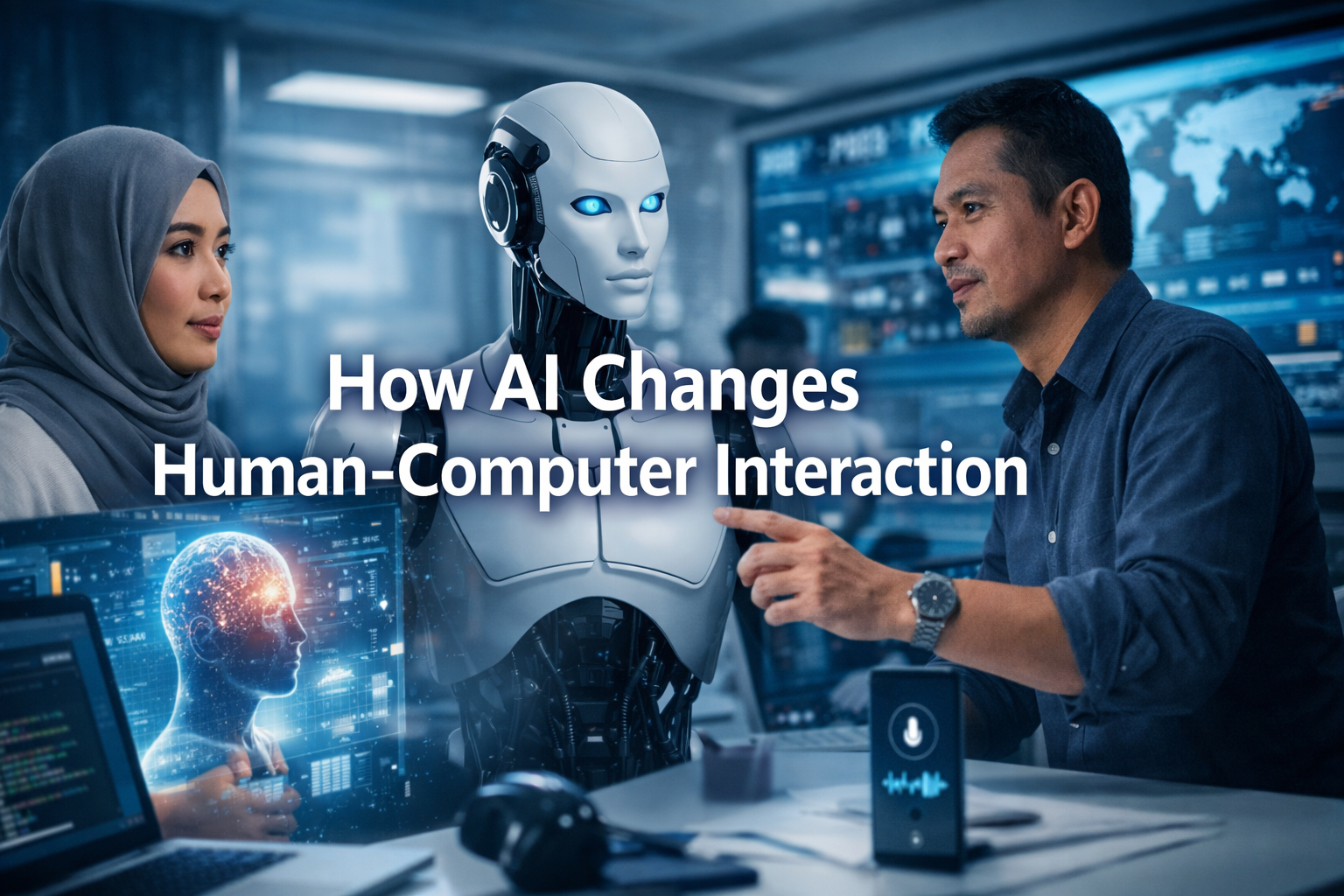
Key Insights:
- AI is shifting human-computer interaction (HCI) from static interfaces to adaptive, intelligent systems.
- Conversational AI, predictive UX, and multi-modal interfaces are redefining digital product strategy in Malaysia.
- Trust, governance, and cultural context (Bahasa Malaysia, PDPA compliance) are now core UX considerations.
- AI-driven user experience requires cross-functional collaboration between UX, engineering, and data teams.
- Organisations that understand how AI changes human-computer interaction can build competitive, future-ready digital ecosystems.
For decades, human-computer interaction was built around buttons, forms, and structured workflows.
Today, AI-powered systems are reshaping how users interact with technology — from conversational assistants to predictive enterprise platforms.
For digital transformation managers, technology decision makers, and UX designers in Malaysia, understanding how AI changes human computer interaction is essential for:
- Designing scalable digital products
- Improving AI-driven user experience
- Managing governance risks
- Building intelligent enterprise systems
This article provides insights into the structural shifts happening in HCI and what they mean for Malaysian organisations navigating digital transformation.
Common Misconceptions About AI in HCI
| Common Misconception | What It Is Now (Reality of AI in HCI) |
|---|---|
| AI is just automation. | AI enables adaptive, learning systems that predict and generate responses beyond fixed rules. |
| Chatbots equal AI transformation. | True AI transformation affects workflows, data systems, UX design, and decision-making processes. |
| AI can be added later without architectural redesign. | AI requires data infrastructure, model integration, and system-level redesign from the start. |
| AI eliminates the need for UX designers. | UX designers are more critical, designing AI interactions, trust systems, and human oversight flows. |
| AI systems are self-managing without governance. | AI requires ongoing monitoring, bias control, compliance checks, and human-in-the-loop supervision. |
The Structural Shift: From Interfaces to AI Systems
Understanding how AI changes human computer interaction begins with recognising that interaction is no longer command-based — they now predict and adapt based on context and data.
This shift impacts not just UX, but also data architecture, system design, and AI governance frameworks.
Traditional HCI relied on pre-defined logic such as:
- Clear user inputs
- Predictable outputs
- Rule-based flows
The above foundation has been disrupted and in today’s intelligence systems AI can:
- Interpret natural language
- Predict user intent
- Learn from behavioural patterns
- Generate contextual responses
Five Major Transformations in AI-Driven HCI
From Command-Based UI to Conversational AI
Conversational interfaces are replacing structured navigation.
Instead of:
- Clicking through dashboards
- Filling complex forms
Users now:
- Ask questions
- Give prompts
- Refine outputs iteratively
Conversational AI reduces friction but increases complexity. UX design must now handle:
- Intent ambiguity: When user requests have multiple possible meanings
- Model uncertainty: When there is uncertainty about AI’s output
- Context management: Tracking conversation history to maintain relevant responses
For Malaysian enterprises, this affects:
- AI-powered customer service
- Enterprise copilots
- Smart internal knowledge systems
From Deterministic Logic to Predictive UX
When examining how AI changes human computer interaction, predictive behaviour is one of the most transformative shifts. It changes users from operators to supervisors.
In traditional systems:
- Same input = Same output
In AI systems:
- Same input = Context-dependent output
This paves the way for predictive UX — where systems anticipate needs and suggest actions.
Examples in Malaysia:
- E-commerce recommendation engines
- AI-enhanced fintech risk scoring
- Smart logistics optimization
- HR resume screening tools
From Static Layouts to Adaptive Interfaces
AI allows interfaces to:
- Personalise layouts
- Prioritize information dynamically
- Adjust content based on user behaviour
This redefines UX from visual design to behavioural design. For technology leaders in Malaysia, this means investing in:
- Data infrastructure: Storing, organising, and managing structured, usable data.
- Real-time processing: Instantly analysing data to deliver immediate responses.
- Interaction intelligence models: AI models predicting behaviour to improve user interactions.
From Single-Mode to Multi-Modal Interaction
AI enables interaction through:
- Voice
- Text
- Images
- Gestures
Global developments in spatial computing such as Apple Vision Pro — illustrate how interfaces are expanding beyond screens.
While Malaysia is still in early adoption stages, multi-modal AI applications are emerging in:
- Smart retail: AI enhancing shopping through personalization and automated inventory management.
- Industrial automation: AI controlling machines to optimise manufacturing efficiency and safety.
- Healthcare diagnostics: AI analysing medical data to support faster, accurate diagnosis.
- Field service operations: AI assisting on-site workers with real-time insights and guidance.
From Software Tools to AI Collaborators
Perhaps the most significant evolution in how AI changes human computer interaction is the shift from tool to collaborator. AI-driven user experience design now accounts for co-creation between humans and machines.
AI systems can now:
- Draft documents
- Suggest code
- Generate UI layouts
- Analyse datasets
- Automate workflows
This introduces new interaction patterns:
- Prompt engineering
- Human-in-the-loop validation
- Iterative feedback cycles
Strategic Implications for Malaysian Digital Transformation
Governance is now part of interaction design. UX teams must integrate AI governance to mitigate the risks introduced by AI such as:
- Bias risks
- Data privacy concerns
- Compliance requirements (e.g., PDPA)
Data Infrastructure Is Now UX Infrastructure
Digital transformation in Malaysia must prioritize data readiness before scaling AI deployment.
Without clean, structured data:
- AI systems can produce unreliable outputs
- User trust declines
- Brand credibility suffers
Cultural & Linguistic Context Matters
Understanding local nuance is critical when deploying conversational AI systems.
Malaysia’s multi-lingual ecosystem requires:
- Accurate Bahasa Malaysia support
- Context-sensitive content generation
- Inclusive AI interaction models
Conclusion: The Competitive Advantage Lies in Interaction Intelligence
AI is not merely a feature layer. It is redefining interaction paradigms. Understanding how AI changes human computer interaction allows organisations to:
- Build adaptive digital ecosystems
- Improve AI-driven user experience
- Increase operational efficiency
- Maintain compliance and trust
- Stay competitive in Malaysia’s evolving digital economy
For digital transformation leaders, the question is no longer whether to adopt AI.
It is how to integrate AI strategically across interface design, system architecture, and governance frameworks — while remaining discoverable in AI-driven search environments.
If your organisation is investing in AI-powered systems, your content strategy should reflect that evolution.
Consider working with an AI SEO agency in Malaysia to ensure your brand is visible where AI-driven decisions begin — in intelligent search.
Frequently Asked Questions (FAQs) About AI in HCI
How does AI improve user experience design?
AI improves user experience by enabling personalization, predictive UX, conversational interfaces, and adaptive layouts based on real-time behavioural data.
What industries in Malaysia benefit most from AI-driven HCI?
Banking, e-commerce, healthcare, logistics, and education sectors are seeing significant impact through AI-powered interaction systems.
Is conversational AI replacing traditional user interfaces?
Not entirely. Conversational AI complements traditional UI but requires thoughtful integration and governance.
What are the risks of AI in human-computer interaction?
Risks include data bias, inaccurate outputs, privacy violations, over-automation, and loss of user trust.
How should Malaysian organisations prepare for AI-driven transformation?
By investing in:
- Data readiness
- AI governance frameworks
- UX-AI collaboration models
- Talent up-skilling
- Strategic AI roadmapping