Key Takeaways
- AI Predictive Analytics in Marketing transforms decision-making from reactive reporting to proactive forecasting.
- Customer behaviour prediction improves targeting precision and reduces marketing waste.
- Predictive intelligence strengthens budget allocation confidence at leadership level.
- AI enables long-term profitability by prioritizing customer lifetime value.
- Organizations that integrate predictive analytics gain measurable competitive advantage.
Marketing has evolved from intuition-driven decisions to intelligence-powered strategy.
Today, AI Predictive Analytics in Marketing enables organizations to anticipate customer behaviour, optimize budgets, and improve ROI with measurable precision.
For Digital Marketing Managers and Marketing Directors, the ability to forecast customer behaviour, optimize budgets, and prioritize high-value audiences is no longer optional. It is a strategic advantage.
This article explores how AI-powered forecasting transforms marketing decision-making and how leaders can implement it effectively.
What Is AI Predictive Analytics in Marketing?
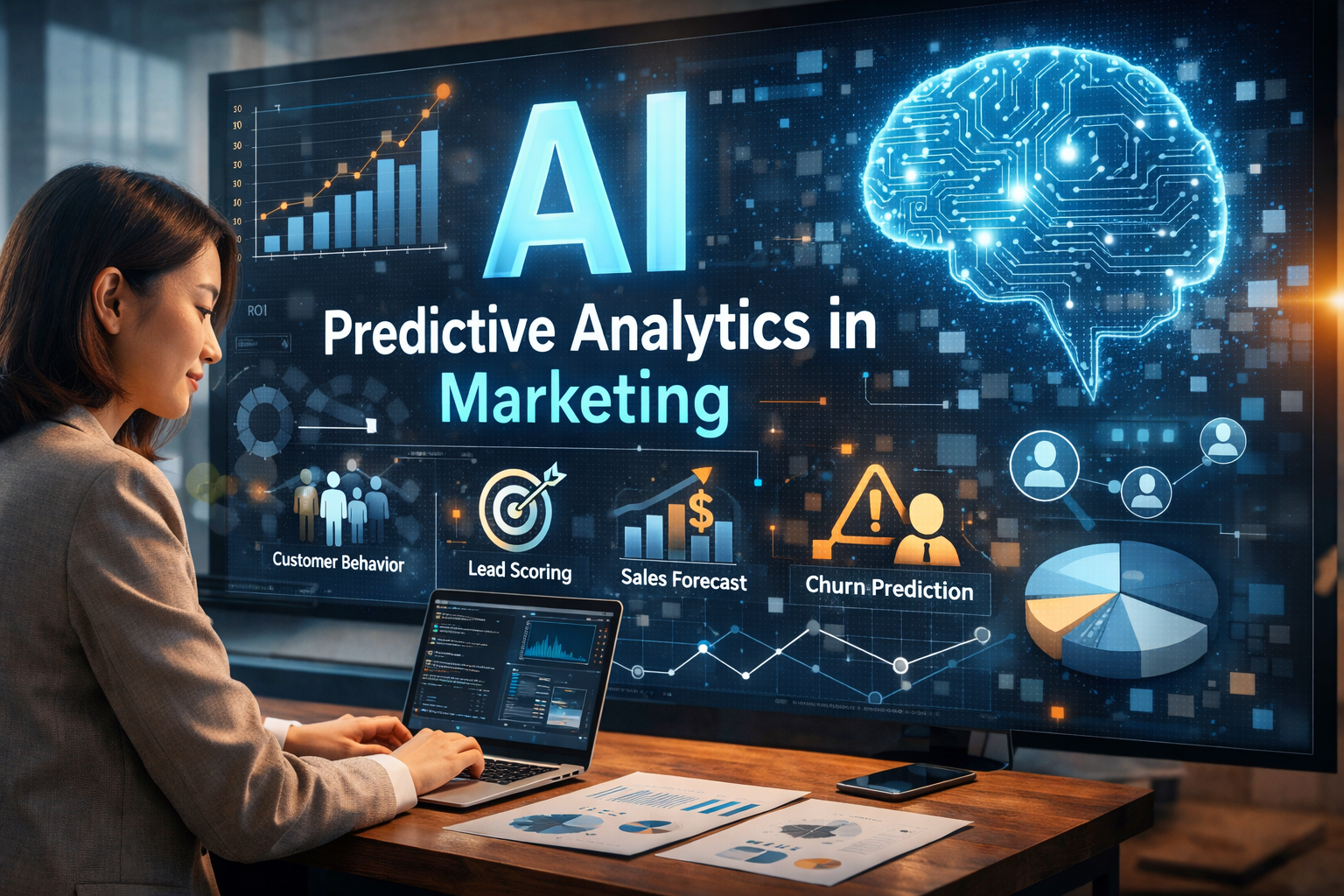
AI Predictive Analytics in Marketing refers to the use of artificial intelligence, machine learning, and statistical modeling to analyze historical and real-time data in order to predict future outcomes.
It enables businesses to forecast:
- Purchase probability: Predicts how likely a customer will buy a product or service.
- Customer churn risk: Estimates which customers are at risk of leaving or unsubscribing.
- Campaign ROI: Forecasts the expected return on investment (ROI) for marketing campaigns.
- Lead conversion likelihood: Identifies which leads are most likely to become paying customers.
- Customer lifetime value (CLV): Predicts the total revenue a customer will generate over time.
- Engagement trends: Anticipates future customer interaction and content engagement patterns.
How AI Predictive Analytics Improves Marketing Decision-Making
Unlike traditional analytics that explains what already happened, predictive analytics forecasts what is likely to happen next — allowing marketing leaders to implement strategic marketing strategies before results decline.
1. Data-Driven Audience Targeting
Platforms like Google Analytics 4 provide predictive metrics such as purchase probability and churn likelihood, contributing to lower ad spend costs and improved campaign precision. Instead of broad segmentation, predictive models analyze behaviour patterns such as:
- Data-Driven Audience Targeting: Uses predictive insights to identify high-value audiences and optimize marketing efforts.
- Browsing Frequency: Tracks how often users visit to determine engagement and purchase intent.
- Engagement Depth: Measures interaction intensity to identify highly interested prospects.
- Purchase Cycles: Analyzes buying patterns to predict timing of customer purchases.
- Content Interactions: Evaluates how users engage with content to guide targeting and personalization.
2. Intelligent Lead Scoring
Intelligent Lead Scoring leverages AI-powered CRM systems like HubSpot and Salesforce Marketing Cloud to automatically evaluate leads using behavioural signals such as:
- Website visits
- Email engagement
- Past interactions
By identifying high-probability prospects, sales teams can prioritize their marketing efforts to focus on the most promising opportunities, and ultimately improve conversion rates and overall sales efficiency.
3. Budget Optimization & Forecasting
AI models simulate multiple performance scenarios across paid, organic, and owned channels. For smarter and more effective budget allocation marketing leaders can forecast:
- Budget Optimization & Forecasting: Uses AI to simulate campaign outcomes, guiding efficient budget allocation across channels.
- Cost Per Acquisition: Predicts the average expense to acquire a paying customer.
- Expected ROAS: Forecasts potential return on ad spend (ROAS) for marketing campaigns.
- Seasonal Trends: Anticipates periods of higher or lower customer engagement and conversions.
- Channel Saturation: Identifies when marketing channels reach maximum audience capacity, avoiding overspending.
4. Customer Lifetime Value (CLV) Prediction
AI predictive models go beyond single transactions, identifying customers with the highest long-term value.
By analyzing purchasing patterns, engagement behavior, and historical transactions, marketers can optimize for:
- Repeat purchases
- Cross-selling
- Upselling strategies
This approach shifts focus from short-term gains to sustainable revenue growth and long-term customer profitability.
5. Churn Prevention & Retention Automation
AI can predict early churn signals, including reduced engagement, lower activity, and declining purchase frequency. Platforms like Netflix leverage these insights to deliver personalized content and targeted retention campaigns.
By proactively addressing potential churn, marketing and product teams can enhance:
- Customer retention
- Reduce acquisition pressure
- Improve lifetime value across subscriber or customer bases.
Implementation Framework for Marketing Leaders
Step 1: Strengthen Data Infrastructure
Unify data from CRM, website analytics, ad platforms, and email systems to create a clean, centralized foundation for accurate predictive analysis.
Step 2: Define Strategic Objectives
Set clear, measurable goals such as improving ROAS, reducing churn, or boosting customer lifetime value to guide predictive modelling efforts.
Step 3: Activate Built-In AI Features
Leverage existing AI tools within marketing platforms to analyze behaviour, forecast trends, and optimize campaigns without extensive customized development.
Step 4: Train Teams on Insight Interpretation
Equip your organization’s marketing and sales teams to translate AI-generated probabilities into actionable strategies for targeting, retention, and campaign optimization.
Conclusion: From Predictive Intelligence to Search Visibility
AI Predictive Analytics in Marketing empowers businesses to forecast outcomes, optimize performance, and make smarter strategic decisions. It reduces uncertainty and turns marketing into a probability-driven growth engine.
However, predictive performance alone is not enough.
As search engines and generative AI platforms evolve, your content must also be optimized for AI-driven discovery. Predictive insights should inform not just campaigns — but also how your brand appears in search results, structured data ecosystems, and AI-generated answers.
That’s where strategic AI-SEO alignment becomes critical.
If you want to combine predictive marketing intelligence with search visibility optimization, structured data strategy, and AI-ready content frameworks, partnering with a reputable SEO agency can help position your business ahead of your competitors.
Frequently Asked Questions About AI Predictive Analytics in Marketing
How does AI predictive analytics improve marketing ROI?
By identifying high-value customers, optimizing budgets, and prioritizing high-probability leads.
Which businesses can benefit from predictive analytics in marketing?
From SMEs to enterprises across e-commerce, SaaS, retail, finance, and digital agencies.
What data is needed for predictive analytics in marketing?
CRM data, website interactions, ad platform performance, email engagement, and transactional history.
How is predictive analytics different from traditional marketing analytics?
Traditional analytics reports past results; predictive analytics forecasts future outcomes and recommends actions.
Can predictive analytics help with customer retention and churn reduction?
Yes, AI detects early churn signals and enables proactive retention strategies.